
PINCH: Precision tIming in the quest for New physiCs at LHC
Bando Prin 2022 - Decreto Direttoriale n. 104 del 02-02-2022 Settore ERC PE2 “Fundamental Constituents of Matter”
Project at a Glance

More details about the CMS Phase 2 Upgrade:
Team and Institutions
The PINCH project is carried out by researchers from the Istituto Nazionale di Fisica Nucleare (INFN) and Sapienza Università di Roma and Università degli Studi di Trieste, in close collaboration with the CMS experiment at CERN. The team combines expertise in precision timing detectors, detector hardware characterization, trigger systems, and advanced reconstruction techniques for collider experiments. The project is coordinated by Livia Soffi, Daniele Del Re, and Vieri Candelise, who contribute complementary experience in detector development, software reconstruction, and physics analysis within CMS. The project supports three PhD students actively involved in detector studies, reconstruction development, and performance evaluations. The strong integration of hardware activities and reconstruction ensures a coherent approach to addressing the experimental challenges of the High-Luminosity LHC.
Scientific Motivations
Project Main Activities
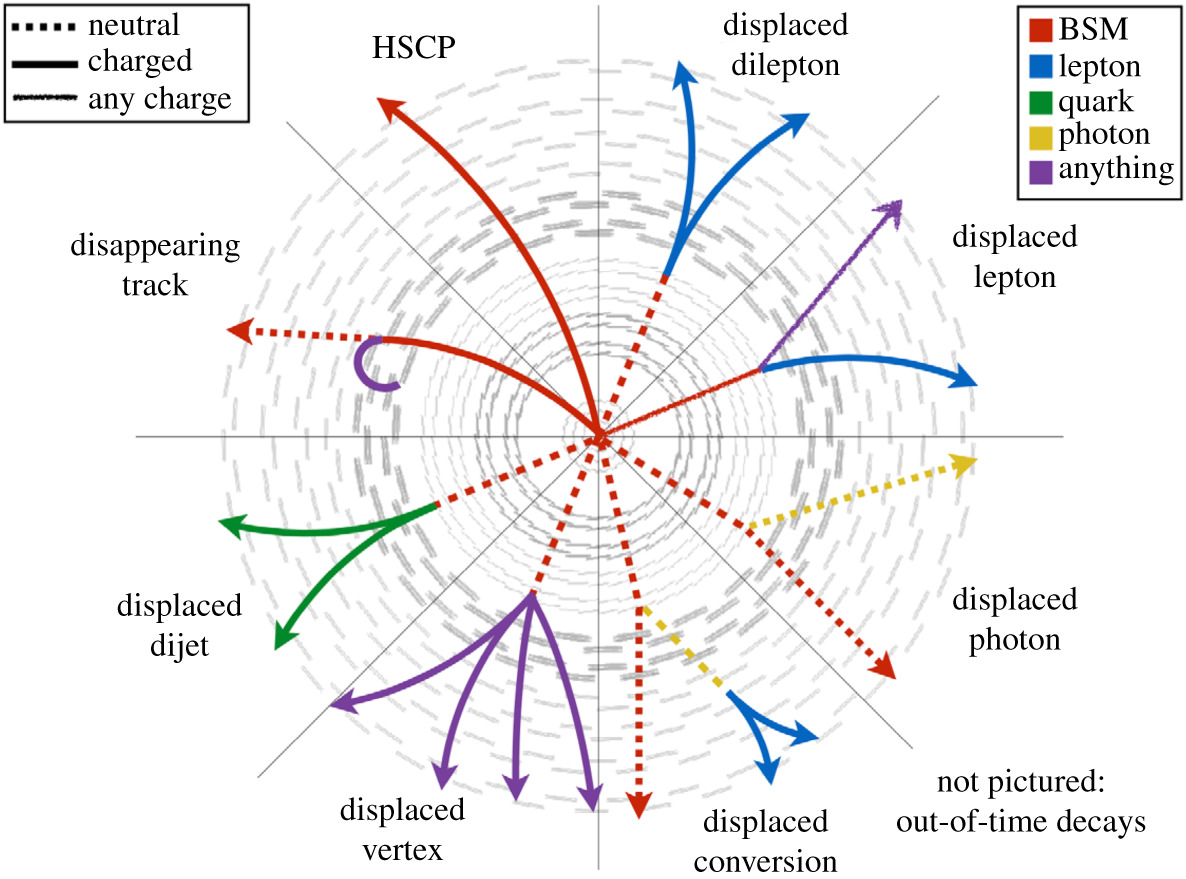
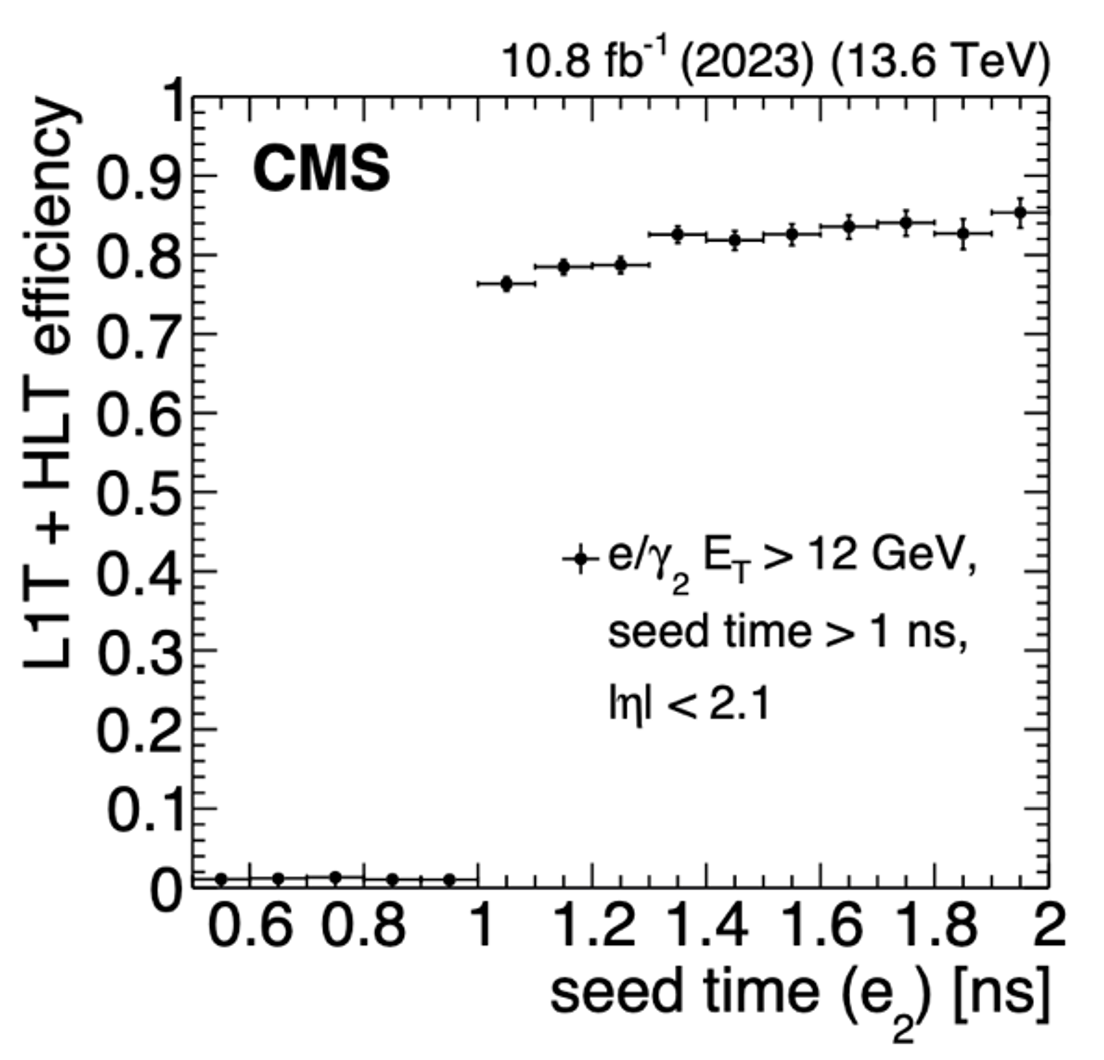
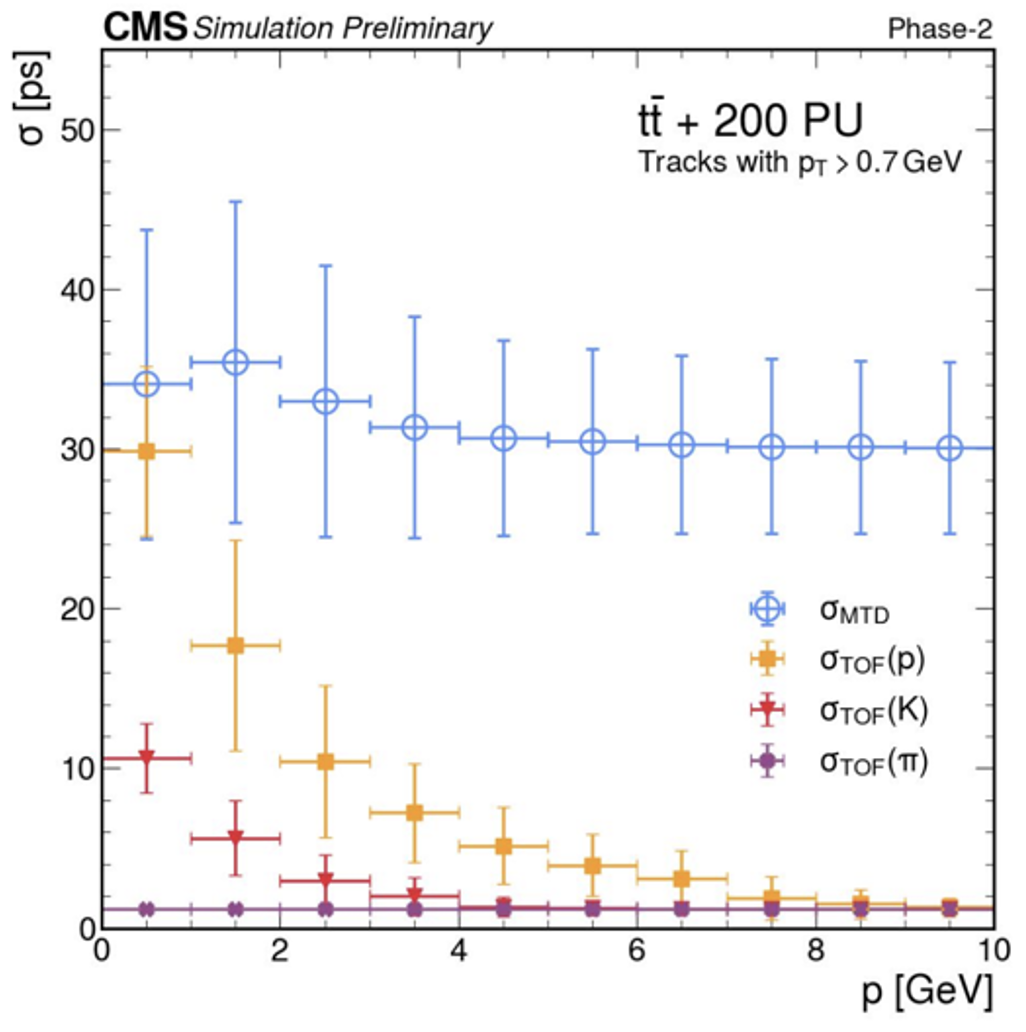
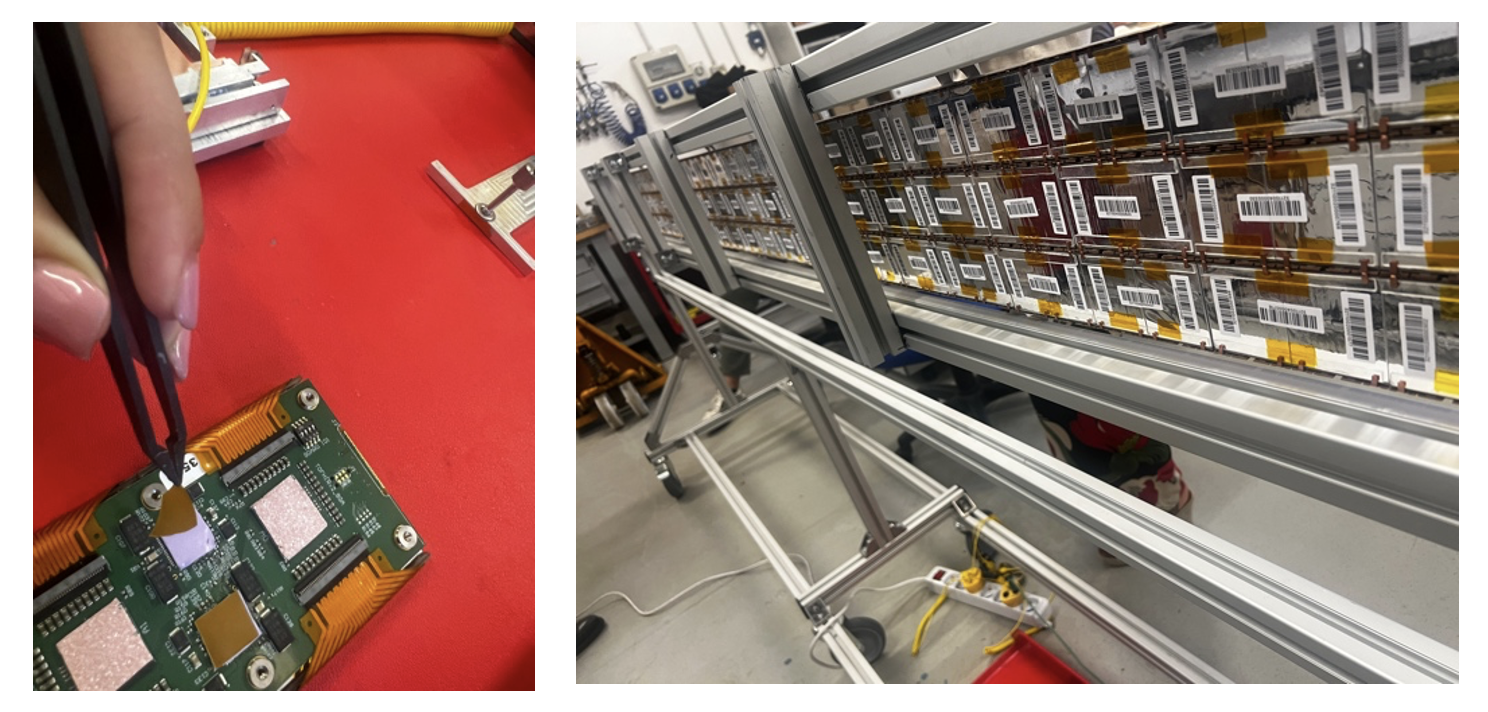
Although the project is primarily focused on the High Luminosity LHC (HL-LHC) program, it builds on Run 3 timing-based trigger studies that provide essential experimental validation and performance benchmarks. These studies demonstrate how precision timing adds a new trigger dimension, enabling CMS to identify non-prompt and delayed signatures relevant for Beyond the Standard Model (BSM) and long-lived particle (LLP) searches that evade traditional prompt-object selections. The work focused on the implementation of ECAL timing at the High-Level Trigger (HLT), using the seed-crystal time as the primary observable for delayed-object triggers. For non-prompt electrons or photons produced by LLP decays inside the tracker, expected time delays are at the nanosecond level—well separated from the intrinsic ECAL timing resolution. This allows explicit timing thresholds to be applied at the HLT, providing robust identification of delayed candidates. Trigger efficiency studies using Z → ee events show a sharp turn-on at a seed time of approximately 1 ns, followed by a stable efficiency plateau. A key outcome of this work is the demonstration that ECAL timing becomes even more powerful when combined with the Phase-II MIP Timing Detector (MTD). Building on Run 3 experience, MTD reconstruction extends precise timing to tracks and vertices under extreme pileup conditions, enabling advanced multi-detector triggers. This approach bridges Run 3 validation with the enhanced physics reach of the HL-LHC, supporting real-time selection of non-prompt and delayed signatures. The project focused on exploiting the precision timing capabilities of the MTD to enhance the physics reach of CMS at the HL-LHC, where extreme pileup conditions (⟨PU⟩≈200) demand novel reconstruction strategies. Precise track and vertex timing significantly improves discrimination of LLPs signatures and provides a solid foundation for exporting advanced timing algorithms from offline reconstruction to the online High-Level Trigger. The work followed a coherent and progressive strategy, starting from detector performance validation, advancing through reconstruction-level studies, and culminating in physics sensitivity analyses. Validation of the Barrel Timing Layer (BTL) demonstrated stable and uniform performance, achieving a track timing resolution of approximately 30–35 ps under realistic Phase-II conditions. These results confirm that the BTL meets the design requirements for robust 4D tracking and time-of-flight–based observables at the HL-LHC. Building on this foundation, track time uncertainties were propagated to vertex-level observables using updated reconstruction algorithms that account for mass-dependent hypotheses. The inclusion of MTD timing significantly improves vertex time resolution, suppresses pileup-induced vertex merging, and enhances correct track-to-vertex association, benefiting both Standard Model and BSM analyses. Dedicated studies of track path length uncertainties further refined time-of-flight measurements. Helix-based modeling and full error propagation showed that path length uncertainties contribute only a few picoseconds to the total timing resolution. These studies also identified and corrected a small systematic bias in time assignment, improving the accuracy of track time reconstruction. To enable advanced BSM searches, the project introduced major reconstruction innovations, including the development of merged-cluster objects in the MTD. By recovering split clusters and assigning precise timing to converted photons and secondary particles, these algorithms transform MTD reconstruction into a powerful tool for identifying delayed photons and complex LLP signatures under high pileup. A key physics application of this work is the time-based search for Heavy Stable Charged Particles (HSCPs). Using Phase-II CMS software, a full simulation and reconstruction-level analysis demonstrated a dramatic improvement in time-of-flight resolution compared to Run 3. The resulting work will establish the first fully realistic HL-LHC timing-based BSM sensitivity study. Overall, these developments demonstrate the readiness of both the CMS detector and reconstruction software to exploit precision timing from the start of HL-LHC operations, enabling new classes of searches for non-prompt and long-lived new physics. The hardware activities of the project focused on the development, optimization, and validation of the BTL of the CMS MTD. The work covered the full chain from component qualification to system-level validation, with the goal of achieving and maintaining excellent timing performance under the demanding radiation and operational conditions expected at the HL-LHC. A central aspect of the project was the qualification of LYSO:Ce scintillator crystals, whose performance directly determines the timing capabilities of the BTL. Extensive characterization campaigns evaluated light yield, timing response, temperature dependence, and radiation hardness. Radiation-induced absorption and annealing effects were studied under neutron fluences representative of HL-LHC operation, enabling reliable predictions of long-term performance. Strict quality-control procedures ensured that only crystals meeting stringent optical and timing requirements were selected for module production, with test-beam measurements confirming that the chosen crystals sustain sub-30 ps timing resolution under realistic conditions. In parallel, the silicon photomultipliers (SiPMs) used for light readout were optimized to minimize timing jitter and ensure stable operation after irradiation. Key operating parameters, including overvoltage, gain, and photon detection efficiency, were tuned for optimal performance. To mitigate radiation-induced dark current, thermo-electric cooling was integrated into the SiPM arrays. Extensive thermal and irradiation tests demonstrated that the combined SiPM–TEC solution maintains stable and uniform performance throughout the expected HL-LHC running period and is fully compatible with large-scale production. Following component qualification, BTL sensor modules were assembled by coupling LYSO:Ce crystal arrays with cooled SiPMs and subjected to electrical, mechanical, and functional validation. Dedicated CERN test-beam campaigns confirmed the excellent timing performance at both single-channel and module level, demonstrating sub-30 ps resolution under realistic particle fluxes and irradiation conditions. These results validated the readiness of the BTL modules for large-scale integration. The final stage involved the assembly of BTL trays, each hosting 144 sensor modules and equipped with an integrated cooling system to maintain operation at low temperature, ensuring long-term stability and radiation tolerance. A total of 72 trays form the full BTL barrel structure, providing hermetic coverage for |η| < 1.45. Tray production and assembly are distributed across multiple international centers, with final integration into the CMS Tracker Support Tube at CERN. The project team actively contributed to these assembly activities, which are scheduled for completion through 2026.Timing-based Trigger Algorithms
MTD Reconstruction and Sensitivity to BSM Physics
Development, Assembly and Validation of the MTD detector
Project Deliverables and Publications
The project has produced a comprehensive set of peer-reviewed publications, CMS public notes, and internal notes documenting the research, detector development, and reconstruction innovations.
Peer-Reviewed Publications
- Strategy and performance of the CMS long-lived particle trigger program in proton-proton collisions at √s = 13.6 TeV – arXiv:2601.17544
- Optimization of LYSO:Ce crystals and SiPMs parameters for the CMS MIP timing detector – JINST 19 (2024) P12020
- Transient optical absorption technique to test timing properties of LYSO:Ce scintillators – ScienceDirect 2023
- Integration of thermo-electric coolers into the CMS MTD SiPMs arrays – JINST 18 (2023) P08020
- The CMS barrel timing layer: test beam confirmation of module timing performance – ScienceDirect 2025
CMS Detector Public Notes
- CMS DP-2025/037 – Track time uncertainties at the point of closest approach with MTD (link)
- CMS DP-2024/085 – Update of the vertex reconstruction using track time from MTD (link)
- CMS DP-2024/077 – Barrel Timing Layer crystals quality control plots (link)
- CMS DP-2024/049 – Barrel Timing Layer performance plots (link)
- CMS DP-2024/048 – Improved use of MTD time in vertex reconstruction (link)
- CMS DP-2024/037 – Results of the thermal tests performed using the BTL cooling setup at TIF (link)
- CMS DP-2024/036 – Barrel Timing Layer crystals quality control plots (link)
- CMS DP-2023/093 – Barrel Timing Layer performance plots (link)
CMS Internal Notes
- CMS DN-2026/004 – Expanding the MTD clustering algorithm
- CMS AN-2026/015 – Track path length resolution and uncertainty assessment in Phase-II reconstruction for track time computation
- CMS AN-2026/013 – Time-based search for Heavy Stable Charged Particles: comparison between Run 3 muon detectors and Phase-II MTD performance
- CMS AN-2025/099 – Search for Heavy Stable Charged Particles with high ionization energy loss in the CMS Tracker Run 2 MET dataset and Partial Run 3
- CMS AN-2025/137 – Run 3 Muon timing studies in the conte
Talks and Posters at National and International Conferences
| Type | Title | Event | Speaker | Proceedings / Link |
|---|---|---|---|---|
| Talk | Recent test beam results of BTL sensor prototypes | SIF2023 | F. Lombardi | - |
| Talk | Precision Timing at High-Luminosity LHC with the CMS MIP Timing Detector | TIPP2023 | P. Meridiani | - |
| Poster | Towards a precise measurement of particles time-of-flight with the new MIP Timing Detector for the CMS Experiment | UpgradeWeek2024 | N. Palmeri | - |
| Poster | Quality Control of LYSO:Ce crystals for the CMS barrel MIP Timing Detector | UpgradeWeek2024 | F. Lombardi | - |
| Talk | New ideas for measurements and searches at the HL-LHC | LHCP2024 | L. Soffi | link |
| Poster | Quality control of LYSO:Ce crystals for the CMS barrel MIP Timing Detector | ICHEP2024 | P. Akrap | link |
| Poster | Towards a precise measurement of particles time-of-flight with the new MIP Timing Detector for the CMS Experiment | ICHEP2024 | N. Palmeri | link |
| Talk | Experimental overview of BSM searches (including resonant HH production) | ICHEP2024 | L. Soffi | link |
| Talk | Searches for new physics in CMS in events with photons in the final state | ICHEP2024 | J. Babbar | link |
| Talk | Quality Control of LYSO:Ce crystals for the CMS barrel MIP Timing Detector | Pisa2024 | R. Gargiulo | link |
| Talk | Test beam performance of sensor modules for the CMS Barrel Timing Layer | BTTB2024 | C. Quaranta | - |
| Poster | Towards a precise measurements of particles time of flight with the new MIP Timing Detector in the CMS Experiment at High Luminosity of LHC | IFAE2024 | N. Palmeri | link |
| Talk | Experimental status on BSM searches | LFC2024 | L. Soffi | - |
| Talk | An overview of Beyond the Standard Model searches in CMS with a focus on Italian contributions | CMS Italy meeting 2024 | L. Soffi | - |
| Talk | Young researcher talk: vertex reconstruction with MTD | CMS Italy meeting 2024 | K. De Leo | - |
| Talk | Optimal use of timing measurement in vertex reconstruction at CMS | CHEP2024 | K. De Leo | link |
| Poster | Prospects for HSCP searches exploiting time information: impact of the CMS MIP Timing Detector | SEARCH2025 | T. Pauletto | - |
| Talk | Quality control of LYSO:Ce crystals for the CMS barrel MIP timing detector | SIF2025 | G. Trabucco | - |
| Poster | Enhancing Particle Reconstruction and Identification with the MIP Timing Detector at CMS | EPS2025 | T. Pauletto | link |
| Poster | Optimizing Particle Identification with the MIP Timing Detector at CMS | UpgradeWeek2025 | T. Pauletto | - |
| Talk | Beyond standard model searches: current status and prospects from the experiment side | CorfùFA2025 | L. Soffi | - |
| Talk | BSM physics from CMS and prospects | WHEPP2025 | L. Soffi | - |
| Talk | YOUNG RESEARCHER'S TALK: HSCP searches using muon detectors and TOF in Run3 | CMS Italy meeting 2025 | T. Pauletto | - |
| Talk | Optimization of BTL clustering algorithm | CMS Italy meeting 2025 | P. Akrap | - |
| Talk | 4D vertexing at CMS | Tracking2025 | J. Babbar | - |
| Talk | Track reconstruction with timing in CMS during HL-LHC | Polarized Perspectives 2025 | K. De Leo | - |
| Talk | 4D Tracking at CMS | HSF Seminar 2025 | K. De Leo | - |
| Talk | Summary report from LHC BSM working group | CMS Week 2025 | L. Soffi | - |
| Talk | HSCP with MIP timing | CMS EXOTICA Workshop 2025/26 | S. Tranfo | - |
Impact and Outlook
The project has established a robust foundation in precision timing reconstruction, validated at both detector and software levels. Ongoing refinements—such as track–cluster association, merged-cluster algorithms, and time-of-flight modeling—will enhance performance under extreme pileup conditions (⟨PU⟩≈200). Advanced 4D vertexing and precise timing enable studies of rare long-lived phenomena, opening previously inaccessible regions of parameter space. Reconstruction and trigger strategies from Run 3 and Phase-II MTD will be extended to the online environment, allowing real-time selection of non-prompt events and improved background rejection. Future efforts will expand from single tracks and isolated photons to more complex signatures, including displaced jets, multi-prong LLP decays, and correlated delayed-photon topologies. Hardware work will continue with BTL tray assembly, full system integration, and long-term validation under irradiation.
The results reflect a coordinated effort among INFN institutes, the Universities of Rome and Trieste, and CERN, combining complementary expertise. Individual contributions, though sometimes small, were essential to ensure the detector is fully prepared for HL-LHC operations and that the physics program can capitalize on new data. The project has led to recognition of team members within CMS through coordination and management roles in detector performance, reconstruction, and physics analyses. Importantly, this work lays the foundation for the first fully simulated HL-LHC physics case study—the HSCP analysis—moving beyond generator-level projections to realistic reconstruction-level predictions, establishing a benchmark for future timing-based searches and demonstrating readiness for new physics exploration at HL-LHC start-up.