 HELEN
High
Energy
Physics LatinAmerican-European Network
HELEN
High
Energy
Physics LatinAmerican-European Network
 CERN
CERN
is the
world's largest
particle physics centre and one of Europe’s first joint
ventures (1954) for research and high-tech activities. The CERN
scientific programme is mainly based on
the construction and future
operation of the Large Hadron Collider (LHC)
(due to
start in 2007) and its
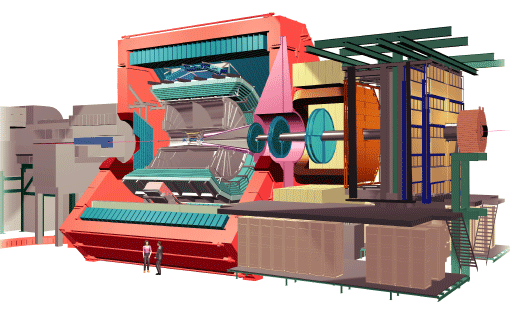
four experiments: ALICE, ATLAS,
CMS
and LHCb. CERN
is currently
building a Long-Baseline neutrino beam, the first in Europe, aimed at
the Gran Sasso Laboratory 730km south of Geneva (CNGS: CERN Neutrino
beam to Gran Sasso). Currently, around 500 institutes and universities
from all over the world, mainly from the Member States, are involved in
the research and technology programme of the Laboratory, in physics and
on a wide range of applied disciplines.
 DESY
DESY
is the
second largest accelerator laboratory in Europe. The
scientific programme is centred on the HERA facility, a high energy
electron-proton collider, and its two experiments ZEUS and H1.
Current
experiments are probing the internal structure of the proton to
unprecedented precision, setting stringent limits to possible
substructures of quarks and leptons and to the production of new
particles. DESY is
at
the forefront of the superconducting technologies for high energy
linear electron accelerators (the TESLA project) and for Free Electron
Laser. Physicists from Institutions all over the world participate in
DESY experiments.
 The Gran
Sasso Laboratories
The Gran
Sasso Laboratories
of INFN are located beside the Gran Sasso
Tunnel
(10.4 km long) on the highway connecting Teramo to Rome (Italy). The
underground structure consists of three experimental halls, enclosing a
volume in excess of 180,000 m3. The experimental
programme
features the
study of solar neutrinos, double beta decay, and the search for dark
matter. The Laboratory will host two detectors (OPERA, ICARUS) for CNGS
from CERN (at a distance of 730 km) built and operated by wide
international collaborations.
 The Pierre
Auger Observatory
The Pierre
Auger Observatory
in Mendoza (Argentina) is the most ambitious
project ever undertaken for the study of the ultra high energy cosmic
rays (UHECR). There is no known acceleration mechanism to reach such
energies. The PAO is a hybrid detector, combining information from
ground-based particle detectors and atmospheric fluorescence detectors.
More
than 200 physicists from 55 institutions now collaborate in
building the Observatory. There are projects to build a similar
installation in the Northern Hemisphere.